
Traditional Generator
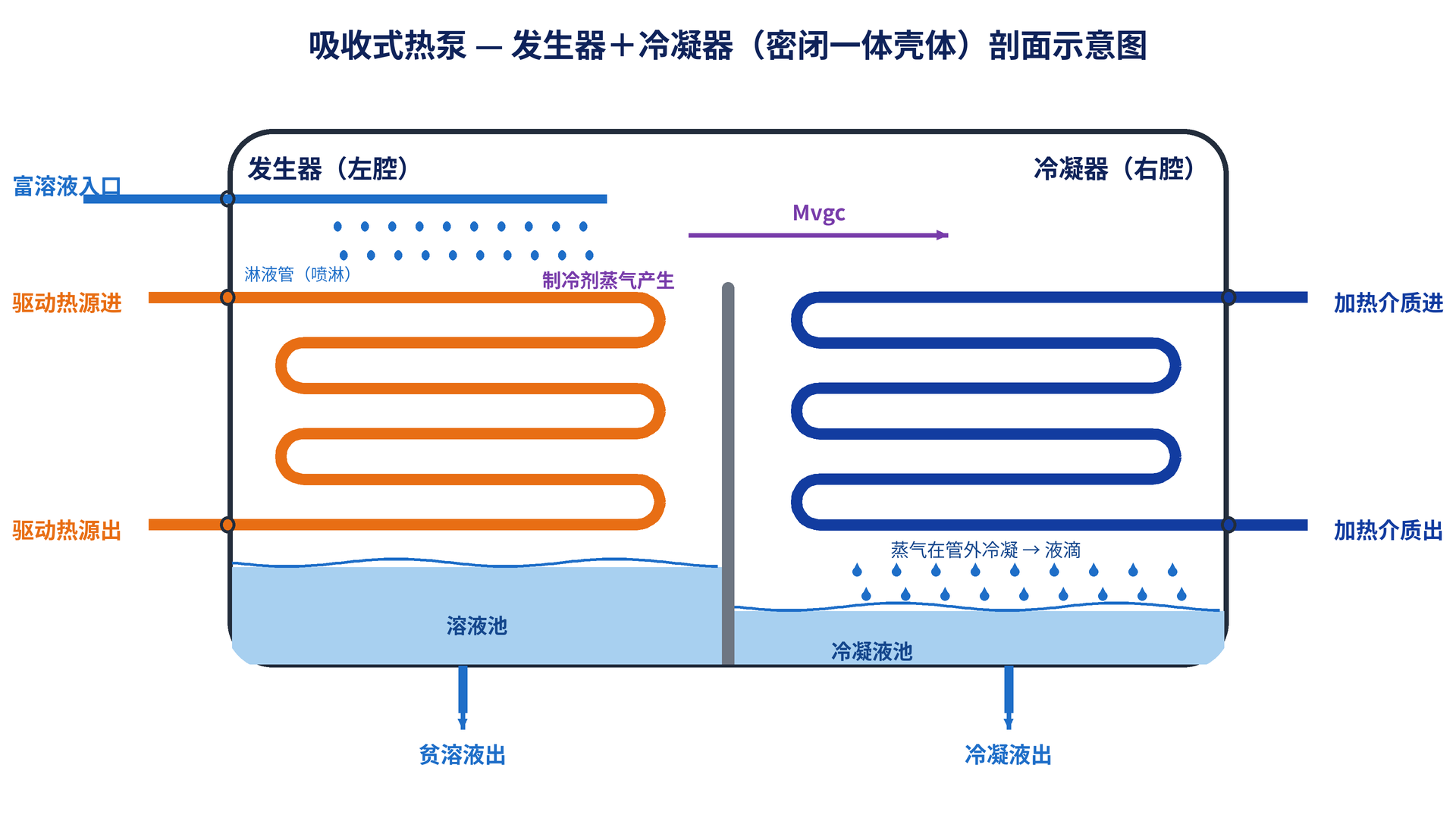
Trial calculation: from generator outlet back to inlet
Given the outlet solution (sgp) concentration and flow and the outlet vapour flow, back out the inlet rich-solution flow and concentration; the condensing temperature Tcond fixes the high-side pressure Pgen (pure-water saturation pressure, Wagner equation); Tsgp then follows from Pgen and ξsgp, and Qg from the inlet/outlet enthalpies, with a binary choice of vapour-enthalpy booking. Assumption: the outlet vapour carries no absorbent (true for LiBr–water).
ṁsgr inlet rich-solution flow = 1.100 kg/s; ξsgr rich-solution concentration = 55.00 %; Tsgp outlet weak-solution temperature = 86.35 °C; Pgen = 0.00739 MPa
Qg generator heat input = 284.1 kW (solution-side balance)
Specific enthalpies: hsgr(Tsgr, ξsgr) = 166.9 kJ/kg; hsgp(Tsgp, ξsgp) = 206.3 kJ/kg; hv,gc (vapour, selected booking) = 2613.5 kJ/kg
ṁsgr = ṁsgp + ṁv,gc; ξsgr = ξsgp·ṁsgp / ṁsgr; Tsgp from inverting Psol(Tsgp, ξsgp) = Pgen; Qg = ṁv,gc·hvap + ṁsgp·h(Tsgp, ξsgp) − ṁsgr·h(Tsgr, ξsgr), with tvap = (Tcond + Tsgp)/2 on the superheated booking. On the other booking (saturated vapour enthalpy) Qg = 279.8 kW. Properties from the same set as this site’s trial-calculation library (Patterson solution model, Wagner pure-water line).
1. The balance: three equations side by side
The worked example is the lumped component model of Yang Yanyan's 2013 Dalian University of Technology master's thesis on a single-effect LiBr–water chiller. The generator is one control volume; its energy balance (Eq. 2.30 of the thesis) books the heat on both sides of the wall in a single line — heating-water side on the left, solution side on the right:
Qgen = ṁh cp,h (th1 − th2) = (ṁa − ṁr) h6 + ṁr h10 − ṁa h5 (2.30)
with the heat-transfer equation and the mean temperature difference:
Qgen = Kgen Fgen Δtm (2.31)
Δtm = th1 − t10′ − 0.35 (th1 − th2) − 0.65 (t6 − t10′) (2.32)
Here ṁa is the rich (dilute) solution entering, ṁr the refrigerant vapour raised, (ṁa − ṁr) the weak (concentrated) solution leaving; h5, h6, h10 are the specific enthalpies at the state points of the cycle diagram — inlet solution, outlet solution, outlet vapour. LiBr mass conservation (Eq. 2.33) closes the set. The mean difference is not the logarithmic one: it is a weighted form, 0.35/0.65, taken from the source book below.
2. Provenance
- Component model (the three-equation set): transcribed from reference [47] of the thesis — Dai Yongqing (ed.), Lithium Bromide Absorption Refrigeration Technology and Applications, China Machine Press, 1996.
- Solution properties: Jia Mingsheng (2002) polynomial set for LiBr–water; its enthalpy carries a +418.6 kJ/kg reference offset.
- Water/steam properties: the set transcribed from Wagner, Properties of Water and Steam.
3. The vapour enthalpy: saturated or superheated?
The vapour leaves in contact with boiling solution, at solution temperature — well above the saturation temperature at condenser pressure. Yang's model therefore treats the exit vapour as superheated: its temperature is defined as the mean solution temperature of the generator,
t10 = (t10′ + t6) / 2 (2.36)
and its enthalpy is computed as saturated-vapour enthalpy plus a mean-specific-heat superheat term,
h = h″(ts) + c̄p,m (t − ts) (2.17)
What is the choice worth? Recomputed with IAPWS water/steam properties, the difference Δh = hsuperheated − h″ between the two bookings is:
| ts (condensing) | t10 (vapour) | h″ | h superheated | Δh |
|---|---|---|---|---|
| 35 °C | 80 °C | 2564.5 | 2650.1 | 85.5 |
| 40 °C | 80 °C | 2573.5 | 2649.8 | 76.3 |
| 40 °C | 90 °C | 2573.5 | 2668.8 | 95.3 |
| 40 °C | 100 °C | 2573.5 | 2687.8 | 114.3 |
| 45 °C | 100 °C | 2582.4 | 2687.5 | 105.1 |
| 40 °C | 110 °C | 2573.5 | 2706.8 | 133.3 |
Over the full grid (ts = 35/40/45 °C × t10 = 80/90/100/110 °C) Δh runs from 67 to 142 kJ/kg. Two observations:
- The approximation in Eq. (2.17) is itself accurate: its Δ agrees with the IAPWS values within 0.3–0.9 kJ/kg. What matters is not the approximation but whether superheat is booked at all.
- Per kilogram of refrigerant vapour, Qgen differs between the two bookings by exactly Δh. With Qgen/ṁr ≈ 2800–3200 kJ/kg for a single-effect machine, that is 3–5%, and COP moves by the same relative amount in the opposite direction — a COP of 0.688 computed on saturated vapour reads about 0.66 on superheated vapour. A paper that does not state this choice carries a 3–5% systematic uncertainty in its COP.
The same superheated construction appears in Liu Jinliang (2007) — h′v = hv + Cpg(t − t1) with Cpg = 1.8543 + 5.7221×10⁻⁴ t — and in Fu Mengxian's double-effect ejector-absorption study, whose steam specific heat is the same polynomial, digit for digit. Most other generator balances in the survey book the vapour term without stating which enthalpy was taken; one (Shen, 2005) uses the saturated value h″g explicitly.
4. Accounting notes for this model
- COP = Qeva/Qgen, solution-pump work excluded (design point 0.6879).
- Heat loss of the generator is neglected by a stated global assumption.
- No rectification heat is booked: in a LiBr–water machine the vapour is pure water.
- Both sides of Eq. (2.30) are carried in the same line, so the water-side and solution-side accounts cross-check each other by construction.